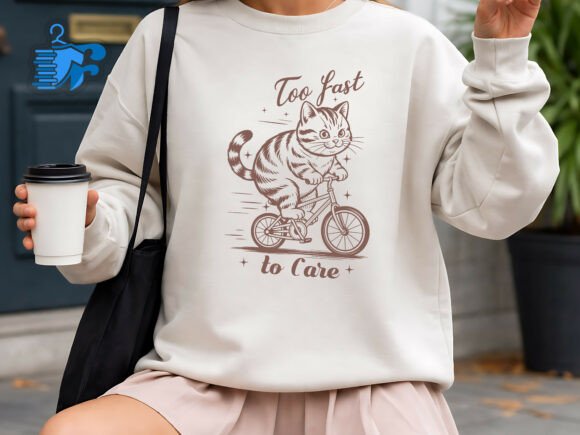
Too Fast to Care Cycling Cat
A Design That Grins Before the Needle Even Moves
First impression? This isn’t just another cat-on-a-bike cliché. Too Fast to Care Cycling Cat lands with playful irreverence—lean lines, a slight forward tilt in the posture, ears pinned back like it’s drafting downhill, and that unmistakable smirk. It’s bold without being busy, stylized but still legible at small scales. As a machine embroidery design, its strength lies in its confident silhouette and intentional negative space—not fussy details, but strong graphic rhythm. That makes it instantly adaptable: think embroidered tote bag for a local bike co-op, a cheeky sweatshirt for a cycling club’s volunteer crew, or even a stitched patch on a child’s backpack (yes, it reads well for baby embroidery when scaled appropriately).
Where It Shines—and Where It Needs a Pause
Too Fast to Care Cycling Cat thrives in custom apparel where personality matters more than precision realism. On a medium-weight cotton sweatshirt? Excellent. The clean outline holds up beautifully under fill stitch, and the curves translate smoothly into satin stitch borders. On a tea towel or kitchen apron? Strong visual impact—especially when stitched in high-contrast thread colors against natural linen or oatmeal canvas. As a digital embroidery file for Etsy sellers, it’s a smart addition to a “fun & functional” shop theme: pair it with coordinating mugs (using the included PNG) or holiday embroidery kits for craft fairs.
But—and this is where real-world testing matters—don’t rush it onto textured fabrics like heavy terry cloth or loosely woven burlap without stabilizer adjustments. The design’s open areas (like the space between front wheel and cat’s paws) can ghost or pucker if the fabric shifts mid-stitch. And on stretchy fabric—think lightweight jersey tees—it needs proper cutaway stabilizer *beneath* and possibly topping for crispness. Curved surfaces like caps? Possible, but only if you’re using a smaller version of the design and confirming hoop size compatibility first. Tiny lettering isn’t present here (thankfully), so no worries about legibility loss—but those thin wheel spokes *will* test your machine’s ability to handle fine running stitch at low density.
Real Project Check: A Boutique Tote Bag Launch
Last month, I prepped Too Fast to Care Cycling Cat for a limited-run embroidered tote bag series for a local café that hosts weekly group rides. We used 12-oz canvas, medium tear-away stabilizer, and matte polyester thread in charcoal and racing yellow. The result? Instant recognition—customers smiled before they even read the tagline. The design didn’t drown in the fabric texture, nor did it look “printed.” It felt handmade, intentional, and commercially polished. That’s the sweet spot: when a Graphics asset becomes a tactile brand moment. For small shop owners, that kind of consistency builds trust faster than any description ever could.
What It Adds to Your Finished Product
- Visual appeal: It stands out without shouting—ideal for curated boutique branding or personalized gifts where subtlety meets wit.
- Stitching clarity: Clean edges mean fewer thread breaks and smoother satin stitch transitions, especially important for craft business volume work.
- Product value: Customers perceive embroidered versions as higher-tier than printed ones—even on affordable blanks—so it lifts perceived value effortlessly.
- Giftability: Its lighthearted tone makes it unexpectedly versatile: great for wedding weekend gear (for the cyclist couple), birthday gifts for teens, or even retirement presents for longtime bike commuters.
Practical Notes Every Embroidery Designer Should Run Through
Before stitching your first Too Fast to Care Cycling Cat, treat it like any new embroidery file—not as a promise, but as a hypothesis to test:
- Run a test on scrap fabric *identical* to your final project—same weight, same stretch, same dye lot if possible.
- Check thread color contrast in both natural and artificial light; what reads bold on screen may mute on dark fabric.
- Review stitch density in your embroidery software—some fill areas might benefit from slight reduction to avoid stiffness on baby embroidery or pillow covers.
- Confirm hoop size requirements early. If you’re planning caps or curved items, verify whether the native design fits standard cap hoops—or whether resizing is needed.
- Inspect small details like wheel spokes and tail tip in zoom view. If they’re under 0.5mm wide in your software, consider simplifying or reinforcing with a tiny running stitch overlay.
- Test black-and-white mockups. Does it retain charm without color? Yes—this design does. That’s a sign of strong graphic foundation.
- Compare light and dark fabric backgrounds side-by-side. Its transparency-friendly PNG means it adapts, but embroidery requires physical thread choices—so simulate both.
- Use appropriate stabilizer: cutaway for knits, tear-away for stable wovens, and fusible + topping for delicate or shiny fabrics like satin baby blankets.
- Double-check licensing terms before selling finished items or bundling the digital embroidery file in a craft bundle. The product description mentions shirt printing and mugs—but commercial embroidery use should be confirmed directly with the seller.
Not Just for T-Shirts—A Quietly Versatile Asset
Yes, it lives comfortably in the T-Shirt Designs category—but reducing it to that undersells it. As an applique design base? Easily. As a focal point for a nursery decor set (stitched on a framed pillow cover or quilt block)? Absolutely. As part of a holiday embroidery collection—say, a “Santa’s Sprint Squad” trio with reindeer and a snow-globe cyclist? Inspired. Its energy translates across mediums because it’s built on proportion, not pixel-perfect detail. That’s why it works for Etsy sellers building cohesive digital product previews and for handmade shop owners who need one design that pulls double duty: on a tote *and* a tea towel, on a cap *and* a baby onesie.
Final Thought: Confidence, Not Compromise
Too Fast to Care Cycling Cat doesn’t ask you to over-engineer it. It asks you to understand your fabric, honor your thread choices, and trust the design’s inherent balance. It’s not the most intricate embroidery file you’ll ever use—but it might be the most reliably charming. For creative entrepreneurs who value both craftsmanship and connection, that’s not a compromise. It’s confidence, stitched in.