Cozy Cat Reading Clipart Set
A Designer’s First Glance: Sweet, Simple, and Stitch-Ready
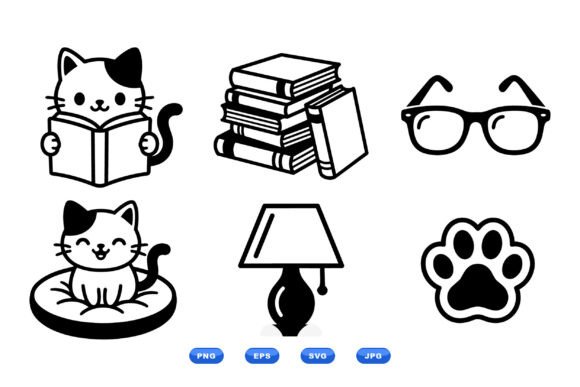
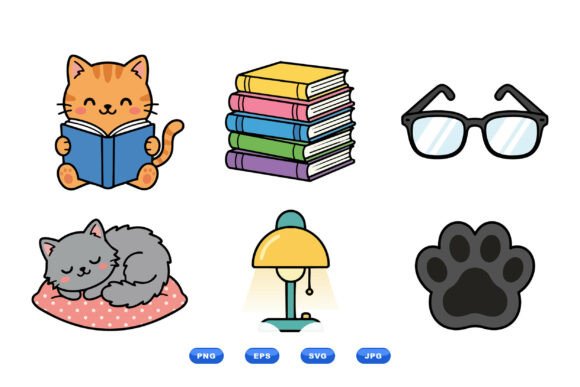
Opening the Cozy Cat Reading Clipart Set feels like flipping open a well-loved storybook—soft, inviting, and full of quiet charm. As an embroidery designer who’s stitched everything from intricate monograms to dense floral motifs on baby onesies and boutique aprons, I immediately noticed how this kawaii flat vector set leans into warmth without clutter. The smiling cat curled over a book, the sleeping cat nestled on a polka-dot pillow, the tiny paw print beside stacked books and round glasses—it all breathes gentle playfulness. There’s no aggressive line weight or sharp contrast; instead, clean shapes, generous negative space, and balanced proportions make it feel inherently *embroiderable*. This isn’t just clipart for stickers or digital mockups—it’s a set built for translation into thread.
Where It Shines: Real Projects That Feel Like Home
I tested the Cozy Cat Reading Clipart Set conceptually across several real-world embroidery projects—and one stood out immediately: a custom embroidered linen tea towel for a small-batch kitchen goods shop. The design’s compact layout (no sprawling limbs or ultra-thin connectors) fits neatly in a 4x4 hoop, and its rounded contours translate beautifully into satin stitch outlines and soft fill-stitch interiors. On a medium-weight cotton towel with tear-away stabilizer, the cat’s face and glasses held clarity without puckering. The paw print and lamp worked perfectly as secondary accents on matching oven mitts or a coordinating napkin set—small enough to read at a glance, expressive enough to carry brand personality.
It also landed well on a lightweight cotton sweatshirt for a children’s boutique. Because the shapes are bold and simplified—not overly detailed or line-heavy—the design stayed legible even at 3.5" wide. Customers responded warmly to the “cozy reading” theme during a holiday pop-up; parents loved gifting the embroidered tote bag version as a first-library-kit companion. For Etsy sellers offering personalized baby embroidery, the sleeping cat on the polka pillow reads instantly as nursery-friendly—gentle, gender-neutral, and emotionally resonant without being cloying.
Where to Pause: Practical Embroidery Boundaries
This set excels in simplicity—but that same strength means it needs thoughtful placement. On stretchy fabrics like ribbed knits (think baby bodysuits or fitted caps), I’d avoid placing the book stack or glasses directly over seams or curved surfaces without testing first—their small geometric forms can distort if hooping tension isn’t precise. Similarly, on dark fabric, subtle details like the cat’s eyelashes or the lamp’s thin base may vanish unless paired with high-contrast thread colors (e.g., cream on navy, not light gray on charcoal). And while the paw print is charming at 1.2", it won’t read cleanly below 0.8" without simplification—so skip it for tiny hat brims or micro-patches.
Also worth noting: because it’s a flat vector illustration rather than a pre-digitized embroidery file, stitch density, underlay strategy, and jump stitch placement aren’t baked in. That means you’ll need to digitize or adapt each element for your machine embroidery design workflow. Don’t assume the glasses frame will stitch cleanly as-is—it may need reinforced satin edges or reduced fill density to prevent stiffness on a baby blanket.
Design Notes Every Embroiderer Should Check Before Stitching
- Test on scrap fabric first—especially if using textured weaves (like burlap tea towels or looped terry) where fine lines can disappear.
- Review thread color contrast early: the kawaii palette relies on soft tones, but embroidery thread saturation differs from screen color—what looks sweet on screen may read muddy in matte rayon.
- Confirm hoop size compatibility: the full scene (cat + books + lamp) likely exceeds 4x4; plan to use individual elements separately for smaller finished products.
- Inspect small corners and curves: the lamp’s curved shade and the cat’s ear tips are potential snag points on layered garments—add slight rounding in digitizing if needed.
- Use proper stabilizer: lightweight cutaway for knits, tear-away for stable wovens, and optional topping for napped fabrics like fleece.
- Check licensing before selling: since this is listed as Graphics under Illustrations, verify whether commercial use—including finished embroidered patches or printable mockups—is permitted for your craft business.
Why It Builds Trust—Not Just Cuteness
In my decade of reviewing embroidery assets for makers, I’ve learned that customers don’t buy “cute.” They buy *recognition*, *reassurance*, and *intention*. The Cozy Cat Reading Clipart Set delivers that through visual consistency: every element shares the same line rhythm, scale logic, and friendly asymmetry. When stitched onto a handmade apron for a local bookstore’s staff gift, it didn’t feel like generic clipart—it felt like a shared language between maker and wearer. That cohesion boosts perceived value, supports brand storytelling (especially for indie shops leaning into “slow reading,” “mindful childhood,” or “cozy learning”), and quietly signals professionalism—even when the final product is hand-finished.
For Etsy sellers, that matters. A cohesive, thoughtfully adapted Cozy Cat Reading Clipart Set used across listings—tote bags, patches, tea towels, even digital embroidery file previews—creates visual continuity that builds buyer confidence faster than isolated designs ever could.
Final Thought: Not Just Clipart—A Craft Business Asset
The Cozy Cat Reading Clipart Set isn’t flashy. It won’t dominate a tradeshow booth or trend on TikTok overnight. But in the hands of a careful designer or small shop owner, it’s quietly powerful: versatile enough for baby embroidery and holiday embroidery alike, simple enough to digitize efficiently, and warm enough to make every finished product feel personally chosen—not mass-produced. If your craft business values clarity over clutter, charm over complexity, and handmade presentation over hype, this set earns its place in your design assets. Just remember: treat it like raw material, not a finished embroidery file. Test, adapt, and stitch with intention—and let the coziness speak for itself.